Police Written Exam: What to Expect and How to Prepare
There is no single national police written exam. Learn how tests such as PELLETB and NTN FrontLine differ,…

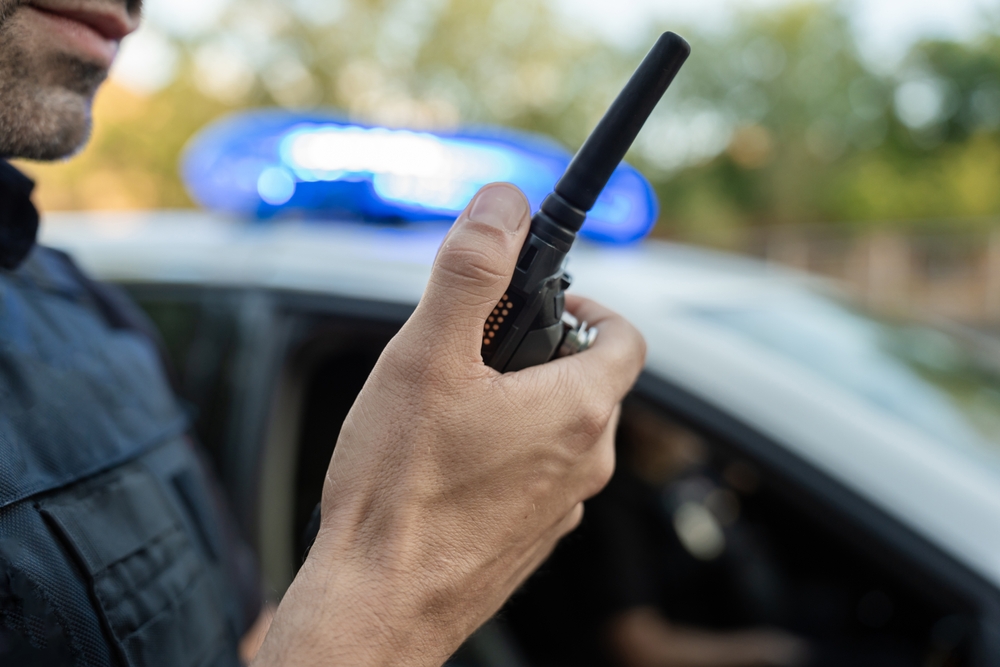
Most police departments in the United States use professional land-mobile radio systems rather than ordinary consumer walkie-talkies. The exact radio, frequency band, network and features depend on the agency.
A patrol officer may carry a portable radio on the duty belt, use a shoulder microphone clipped to the uniform and also have a higher-powered mobile radio installed in the patrol car. Behind that radio is usually a much larger communications system involving dispatch consoles, repeaters, trunked radio infrastructure, talkgroups and sometimes encryption.
There is no single “police radio” used nationwide. But there are common technologies and several manufacturers that appear repeatedly in U.S. public-safety communications.
Police generally use land mobile radio, usually shortened to LMR. These systems are designed for reliable two-way voice communication between officers, dispatchers and other public-safety users.
Modern systems are often digital, and many U.S. agencies use equipment compatible with Project 25, or P25.
The National Institute of Standards and Technology describes P25 as a suite of standards intended to let public-safety radios and system components from different manufacturers interoperate. P25 does not mean every department uses the same radio or even the same frequency band. It means manufacturers can build equipment around common technical interfaces and standards.
That distinction matters. P25 is a standard, not a particular radio brand.
There is no official nationwide market list that tells you exactly how many U.S. departments use each manufacturer. Agencies buy radios through their own procurement processes, regional systems and statewide contracts.
Still, several manufacturers have current product lines designed specifically for public safety.
Motorola Solutions is one of the most visible manufacturers in U.S. public-safety radio.
Its current APX family includes radios such as the APX NEXT and newer APX N models. The APX NEXT is a P25 public-safety radio that can combine traditional LMR voice with broadband features such as LTE, Wi-Fi, GPS-based location services and data applications.
Motorola also makes mobile P25 radios for police vehicles and complete ASTRO P25 infrastructure, not just handheld units.
L3Harris produces another major family of public-safety radios.
The current XL Converge 200P, for example, is a multiband P25 portable supporting VHF, UHF and 700/800 MHz along with LTE, GPS, Bluetooth and Wi-Fi.
L3Harris also supplies public-safety communications infrastructure and network systems, so an agency may use both L3Harris subscriber radios and a larger L3Harris communications system.
KENWOOD Viking, through EFJohnson, is another public-safety radio line used by police, fire and other emergency services.
The Viking VP8000 is a multiband, multi-protocol portable that supports P25 Phase 1 and Phase 2, conventional operation, trunking and several other digital and analog protocols.
This is a good example of why “What radio do police use?” has no one-word answer. An agency can select a radio because it needs compatibility with a particular regional network, frequency band, encryption requirement or legacy system.
BK Technologies also builds P25 public-safety radios. Its BKR 5000 is a current single-band P25 portable supporting conventional operation, Phase 1 and Phase 2 trunking, encryption and GPS.
BK equipment is especially familiar in certain public-safety and government markets, although agency usage varies considerably by region.
Police officers commonly use two different types of radios.
This is the handheld radio carried on the officer.
It is usually clipped into a duty-belt radio holder or carried on an outer vest. Many officers use a remote speaker microphone clipped near the shoulder so they can listen and transmit without pulling the radio off the belt.
Portable radios are designed to survive rain, drops, dirt and daily use. Public-safety models also tend to have large knobs and buttons that can be operated without staring at the radio.
A mobile radio is installed in the police vehicle.
It can generally transmit at higher power than a handheld radio and can use the vehicle’s external antenna. That can improve coverage, particularly in difficult terrain or on the edge of a radio system.
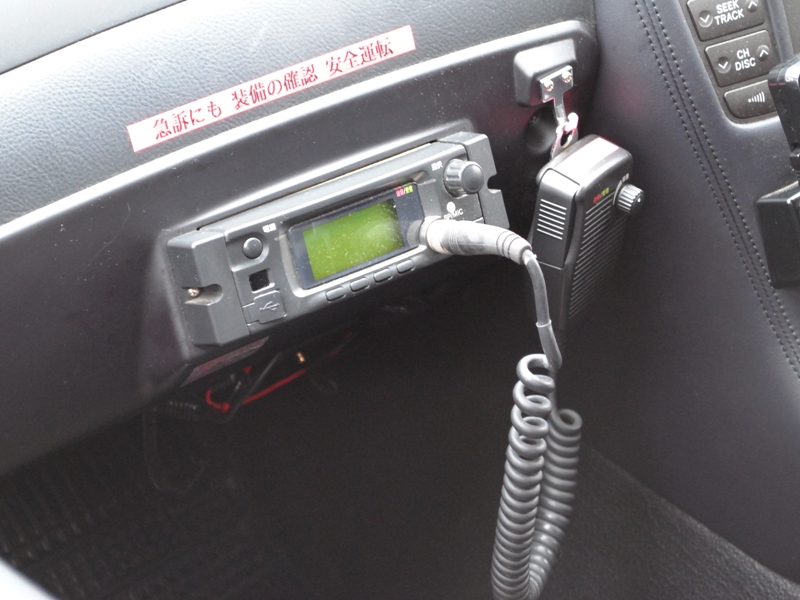
An officer may therefore carry a portable radio while also having access to a mobile unit inside the patrol car.
Project 25 is a group of technical standards for digital public-safety land-mobile radio systems.
NIST explains that P25 was developed because agencies using different manufacturers and radio systems often could not communicate effectively with one another. The standards define interfaces that can allow compliant equipment from different manufacturers to work together.
CISA describes the purpose similarly: P25 standards are intended to promote interoperability among digital two-way LMR products from different manufacturers while meeting public-safety requirements for mission-critical voice communications.
P25 can include:
A department using P25 does not necessarily use the same channels, encryption keys or radio brand as a neighboring department.
Police radio systems can operate in several parts of the radio spectrum.
Common public-safety equipment supports bands such as:
Some modern portable radios are multiband, allowing one device to work across several of those ranges if the radio and system are programmed and authorized appropriately.
The band an agency uses depends on licensing, regional planning, existing infrastructure, terrain and the radio network it belongs to.
This is why asking “What frequency do police use?” without naming the agency or city is usually too broad a question.
This is one of the biggest differences between older or simpler radio systems and many modern public-safety networks.
In a conventional system, a channel is normally associated with a particular radio frequency or pair of frequencies.
If you change channels, you are often changing to a different assigned frequency or repeater.
A trunked system manages a pool of radio frequencies automatically.
Instead of every user staying permanently on one physical frequency, officers select a talkgroup. The radio system then assigns an available channel when someone transmits.
For the officer, it can still feel like selecting “Dispatch,” “Tac 1” or another channel. But behind the scenes, the system is dynamically assigning radio resources.
Trunking makes it easier for large regional systems to support many agencies and talkgroups without dedicating one frequency permanently to every function.
A talkgroup is a logical group of radio users on a trunked system.
Examples might include:
The exact labels differ between systems.
A radio can be programmed with many talkgroups arranged into zones or banks. Officers switch between them using the controls on the radio.
A portable radio does not always communicate directly with the dispatcher’s desk.
In many systems, the officer’s radio transmits to a repeater or network site. The system then carries that transmission through the radio network to dispatch consoles and other radios assigned to the same channel or talkgroup.
Large systems can use multiple towers or simulcast sites to provide coverage across a city, county or region.
This is why radio coverage is a system problem, not simply a question of how powerful an officer’s handheld radio is.
The device clipped near an officer’s shoulder is usually a remote speaker microphone, often shortened to RSM.
It connects to the portable radio on the belt or vest and lets the officer hear and transmit without reaching down for the main radio.
Depending on the system, an RSM can also include features such as an emergency button, programmable controls, audio accessories or even video integration.
The basic advantage is simple: communication stays within reach while the officer’s hands remain available for other tasks.
Some do.
P25 supports encryption, and current public-safety radios from major manufacturers offer encryption options such as AES.
But that does not mean all police radio traffic is encrypted.
An agency can encrypt some talkgroups and leave others clear. A regional system may have encrypted tactical or investigative channels while keeping routine dispatch traffic unencrypted. Policies also change over time.
Encryption is one reason a scanner may be able to identify a system but still be unable to reproduce the voice traffic.
Our guide to whether police scanners are legal covers the separate legal issue of listening to public-safety radio traffic.
Both still exist, but much modern U.S. public-safety infrastructure is digital.
P25 is a digital public-safety standard, although modern radios can sometimes support both digital and legacy analog modes.
For example, the KENWOOD Viking VP8000 supports P25 digital modes as well as FM analog operation. Multi-protocol radios can be useful when an agency has to communicate with older systems or multiple partner agencies.
They can when the systems and operational plans are designed to allow it.
This is called interoperability.
P25 was specifically developed in part to improve the ability of equipment from different manufacturers and agencies to work together. NIST’s P25 Compliance Assessment Program exists to help agencies verify that equipment marketed as P25 compliant actually meets specified standards.
But technical compatibility is only one part of interoperability.
Agencies also need compatible programming, agreed talkgroups or channels, permissions, dispatch procedures and training. Two radios being P25-capable does not automatically mean every officer can simply turn a knob and speak to every neighboring department.
Traditional mission-critical voice still relies heavily on land-mobile radio.
However, newer radios increasingly combine LMR with broadband connectivity.
Motorola’s APX NEXT, for example, supports P25 voice while also using LTE, Wi-Fi and other broadband connectivity for applications and data. L3Harris’ XL-200P similarly combines P25 capabilities with LTE, GPS, Bluetooth and Wi-Fi.
This does not mean the radio has simply become a smartphone. The LMR side remains designed around reliable push-to-talk mission-critical voice, while broadband can add location, messaging, software updates and other data services.
A smartphone is useful, but it is not a complete replacement for a public-safety radio.
Police radios are designed around:
A patrol officer needs to be able to press one button and reach dispatch or everyone on the talkgroup without unlocking a phone, opening an app and selecting a contact.
Police radio systems often use local channel names, talkgroup labels, unit identifiers, signals and radio codes.
Some agencies historically used 10-codes. Others use numerical signals, plain language or a mix of both.
These codes are not universal. A number can mean one thing in one department and something completely different somewhere else.
That is why our Police Radio Codes Explained guide starts with the agency and jurisdiction rather than pretending there is one national codebook.
The most reliable answer normally comes from the agency or the government body that operates the regional radio system.
You may find the information in:
Do not assume that seeing a Motorola radio in a photograph means the entire department uses Motorola. Large agencies can have different radio generations, specialized units and transitional equipment in service at the same time.
These are examples of current manufacturer product lines, not a ranking and not a claim that every police department uses them:
The radio itself is only one part of the communications system. Infrastructure, programming, encryption, dispatch consoles and network design can matter just as much as the name printed on the handset.
There is no reliable national figure that establishes one brand as the radio used by “most” U.S. police officers. Motorola Solutions, L3Harris, KENWOOD Viking and BK Technologies all make current public-safety radios, and local procurement determines what an agency uses.
Many U.S. public-safety systems use P25, but not every police radio system is P25. Agencies can still use other digital protocols, analog systems or mixed environments.
Potentially, if both radios and the system are configured for compatible standards, frequencies, talkgroups and permissions. P25 exists in part to support interoperability across manufacturers, but configuration and operational planning still matter.
A police radio is an authorized two-way communications device that can transmit on the agency’s system. A scanner is primarily a receiver used to monitor compatible radio traffic. A scanner does not give the user authority or technical access to transmit on a police radio system.
The agency may be using encryption, a different talkgroup, a trunked system the scanner is not configured for, or another communications method.
The comparison is not just about transmitter power. Police radios are part of professionally engineered networks using repeaters, towers, system controllers, licensed spectrum and dispatch infrastructure. A portable radio can therefore communicate across a large service area through the network.
Police officers do not all carry one standard national radio.
Modern U.S. agencies commonly use rugged land-mobile radios connected to conventional or trunked public-safety systems. P25 is widespread because it provides standards intended to improve interoperability, while manufacturers such as Motorola Solutions, L3Harris, KENWOOD Viking and BK Technologies offer current police and first-responder radio platforms.
The exact answer still comes down to the individual agency: its radio network, frequency bands, interoperability requirements, procurement decisions and local operating procedures.
This article provides general information about U.S. police communications. Radio systems, frequencies, encryption and equipment vary by agency and jurisdiction.
There is no single national police written exam. Learn how tests such as PELLETB and NTN FrontLine differ,…
Police field training bridges the gap between academy and solo patrol. Learn what FTO means, how phases and…
The police hiring process can include written testing, PAT, oral boards, background checks, polygraph, psych and medical exams,…