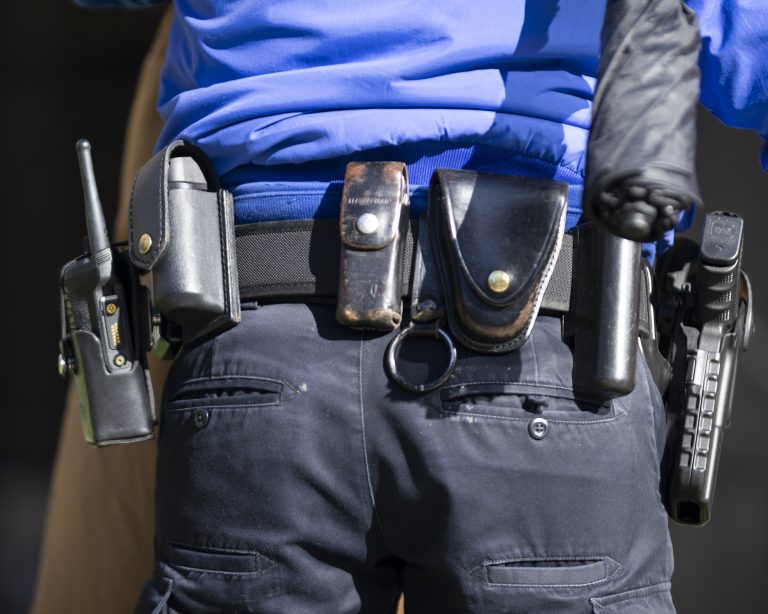
4 Best Law Enforcement Duty Belts for Police Officers (2026)
Compare four of the best law enforcement duty belts for police officers, including Bianchi, 5.11 and Condor options.…

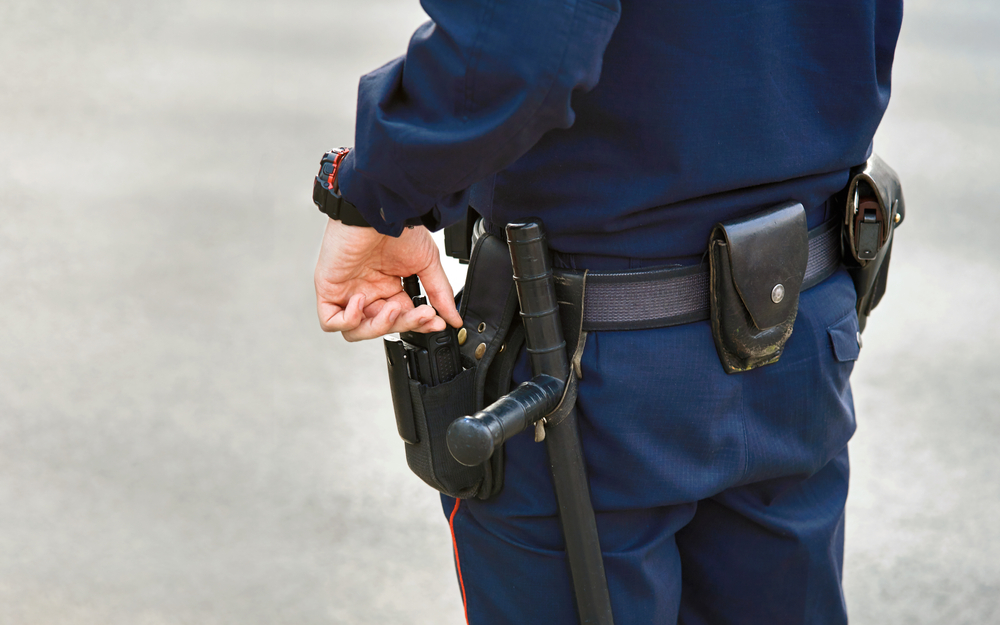
A radio holster is one of those pieces of duty gear that looks simple until you use a bad one for a full shift. The radio is heavy, expensive and something you may need immediately. The holder has to keep it secure while walking, running, fighting, getting in and out of a patrol car and sitting for hours.
Before buying anything, check two things: your exact radio model and your mounting platform. A molded Motorola APX case can be excellent for the radio it was built around and useless for another handset. A MOLLE pouch is not automatically the right choice for a plain 2.25-inch duty belt.
Affiliate disclosure: As an Amazon Associate I earn from qualifying purchases. Some links on this page are affiliate links. Product selection is based on fit, mounting system, manufacturer specifications, duty-use practicality and recurring owner feedback—not on which product pays the highest commission.
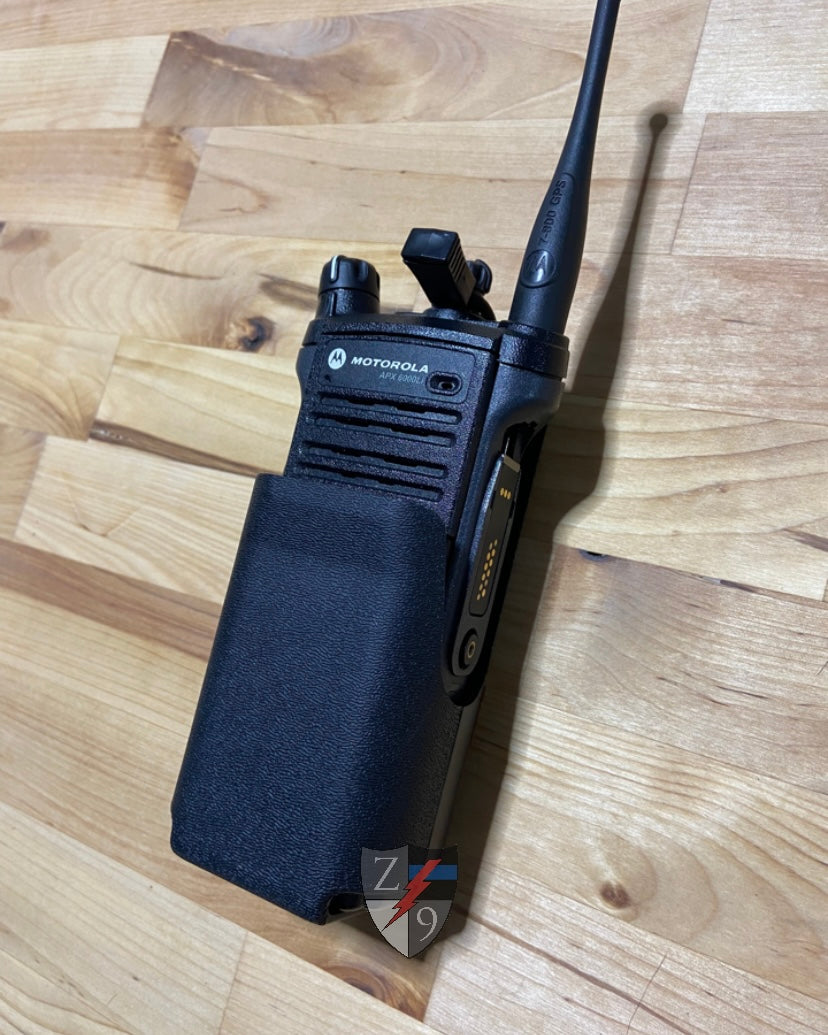
Fit: Model-specific | Mount: Tek-Lok for duty belt
A hard-shell APX carrier rather than a generic pouch. On Amazon, select the Tek-Lok attachment for belt use.
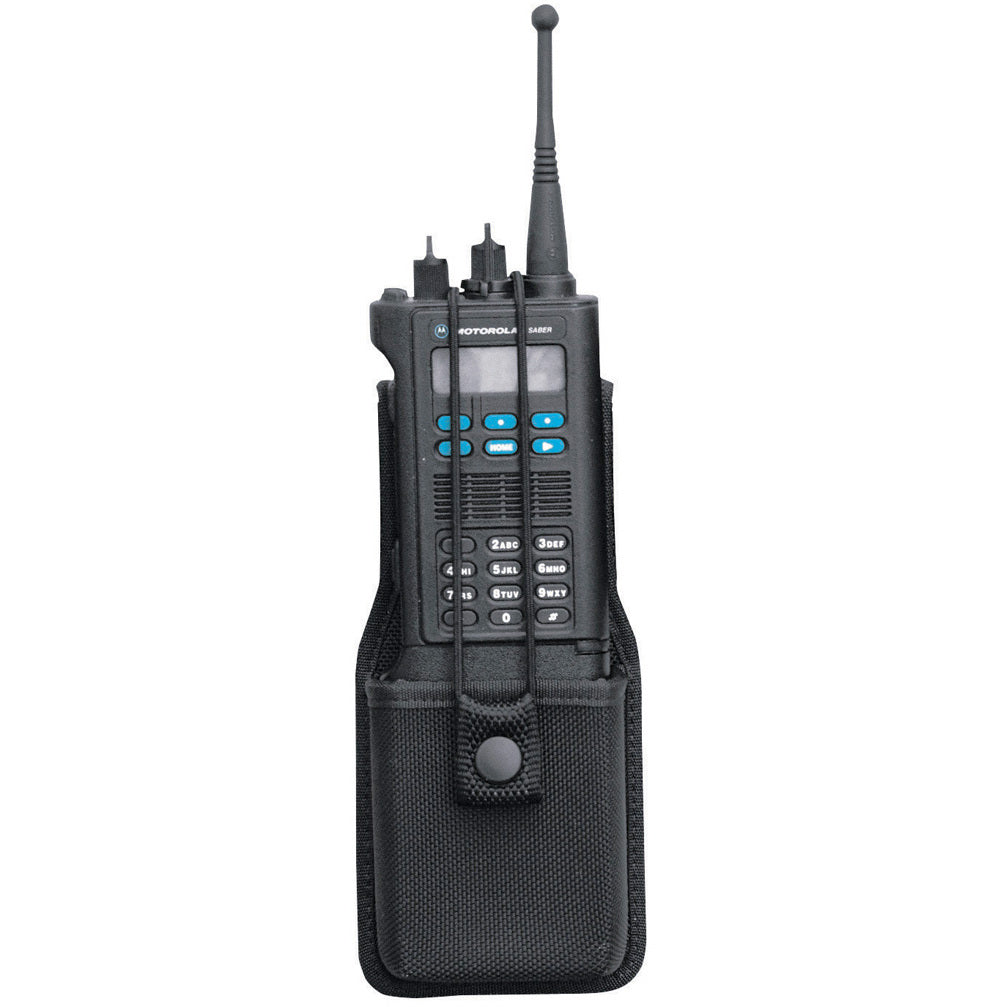
Fit: Universal | Mount: 2.25-inch belt loop
A conventional AccuMold holder that slides directly onto a standard duty belt and uses an adjustable retention strap.
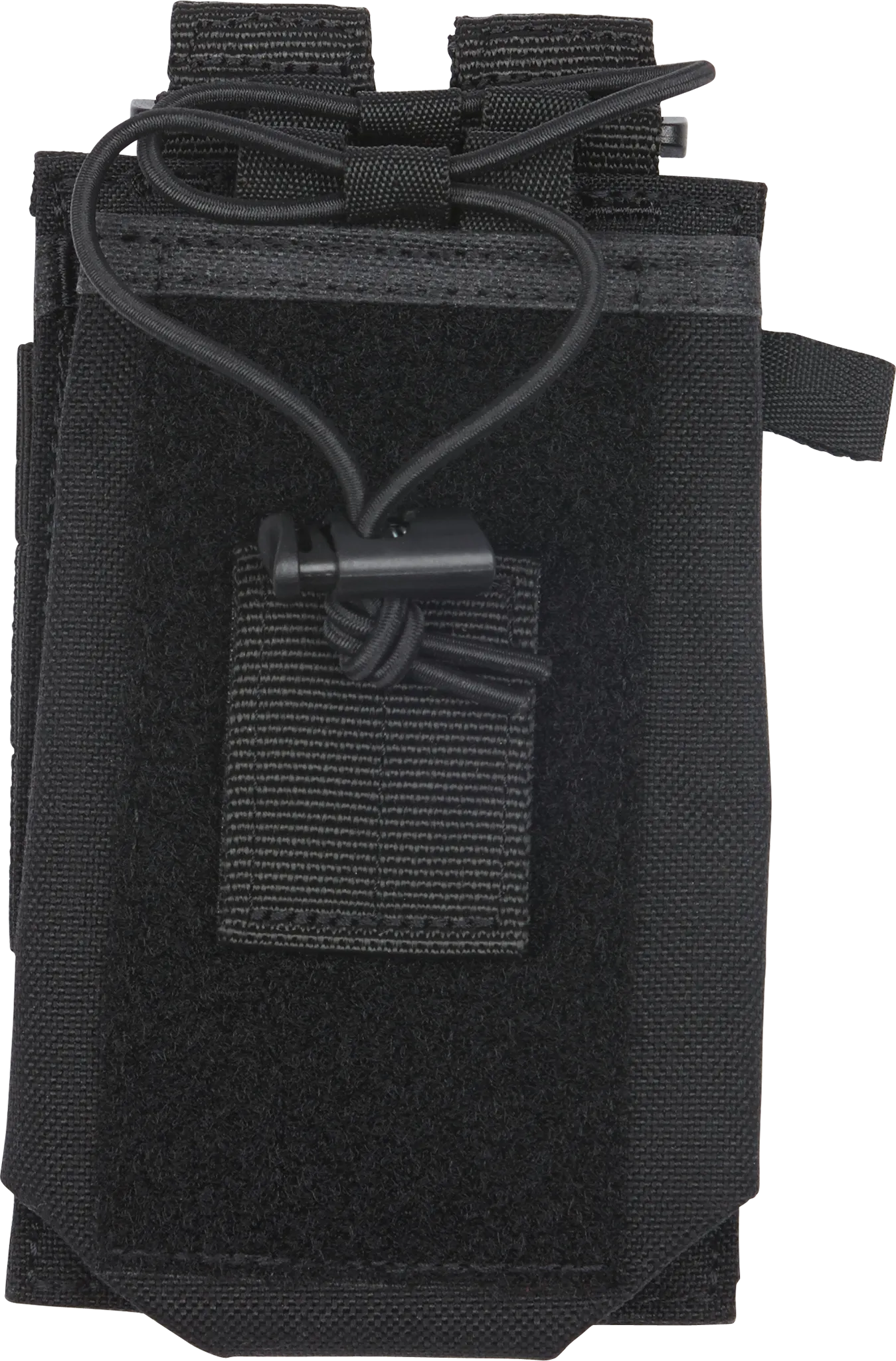
Fit: Universal handset | Mount: MOLLE/web platform
A lightweight nylon pouch for officers running a MOLLE-capable outer carrier or compatible belt platform.
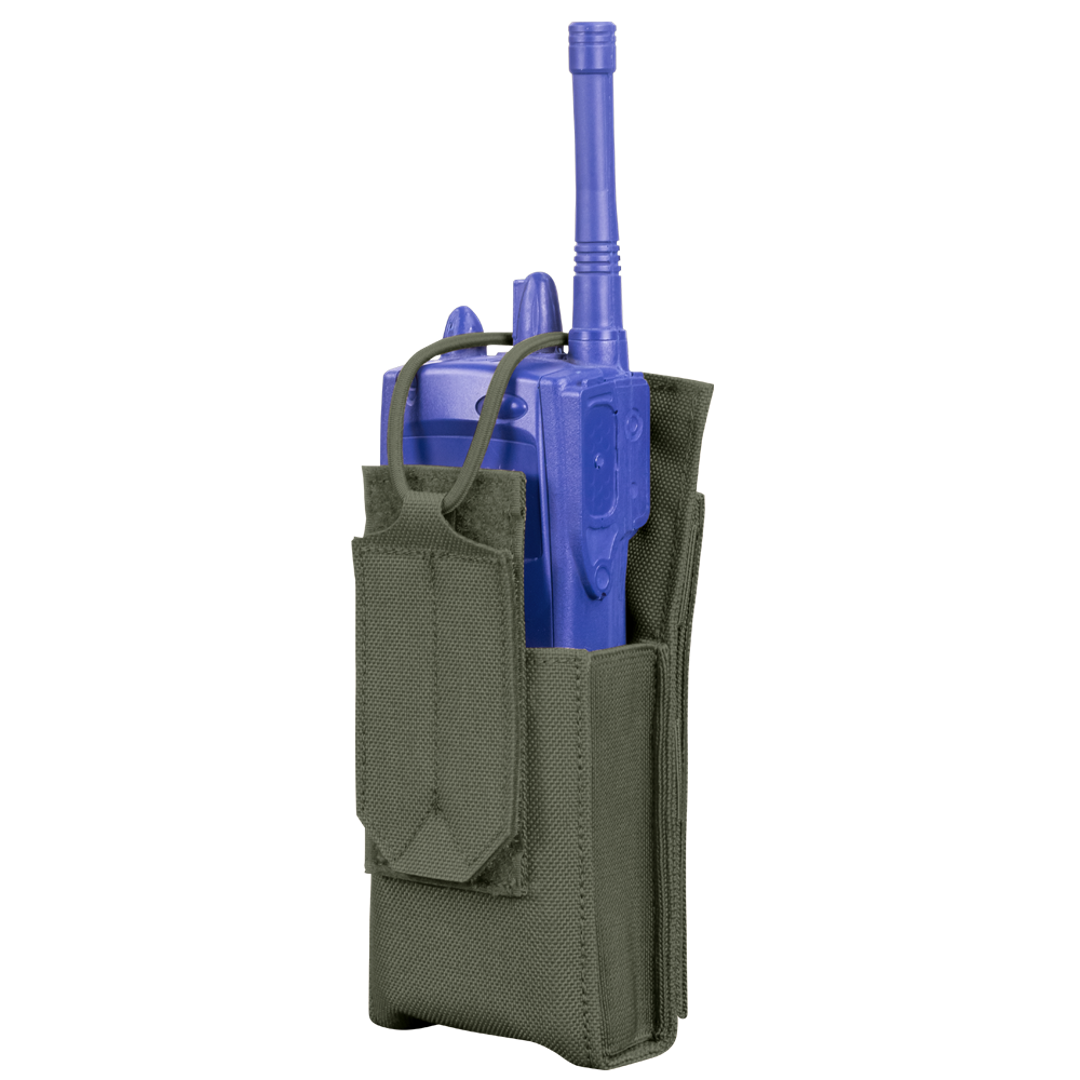
Fit: Most public-safety handheld radios | Mount: MOLLE
An inexpensive open-top pouch with elastic sides and bungee retention.
Start with the radio. If your department issues a Motorola APX6000 or APX8000, a fitted hard-shell carrier can make sense. If radios are shared or issued with different battery configurations, a universal pouch may be safer.
Then check the mount. Traditional police duty belts are commonly around 2 to 2.25 inches wide, while many modern outer carriers use MOLLE/PALS. Some holders move between both systems by changing the attachment; others cannot.
Retention matters too. A radio that stays put while walking can still leave a pouch during a foot pursuit or ground fight. At the same time, retention should not make routine access unnecessarily awkward.
If you are building the belt itself, see our best law enforcement duty belts guide. Our police gear list covers the broader loadout.
If your department issues a Motorola APX6000 or APX8000, the Zero9 Model 5001 is the most purpose-built option here.
Zero9 forms the case around specific Motorola APX families. The APX6000/8000 version supports the newer PMNN4547A extended battery as well as slimmer battery configurations. A bungee retention lanyard adds security while leaving the PTT button and accessory port accessible.
The mounting choice is important: Tek-Lok for duty belts, Molle-Loks for MOLLE vests and D-rings for shoulder straps.
Zero9 has an unusually large feedback base for specialized police gear. The manufacturer shows more than 200 reviews on the APX-series case. Recurring positives are secure fit, durability, easy cleaning and access to controls. The limitation is the same thing that makes it good: you need the version made for your radio and battery setup.
Best for: Motorola APX6000/8000 users who want a rigid, model-specific carrier.
Skip it if: Your agency changes radio models often or you need one pouch for unrelated handsets.
The Bianchi 7314 is the classic police-duty-belt option. It uses AccuMold trilaminate construction with a ballistic-weave exterior and Coptex lining, and slides directly onto a 2.25-inch duty belt.
Instead of being molded for one radio, it holds most handheld radios. An adjustable elastic security strap with snap closure provides top retention.
Best for: Traditional 2.25-inch uniform duty belts and agencies where a conventional black nylon appearance fits policy.
Skip it if: You want a MOLLE mount or a custom-molded APX carrier.
Manufacturer reference: Bianchi 7314 specifications.
The 5.11 Tactical Radio Pouch is designed around a universal web/MOLLE platform rather than a plain traditional belt loop.
5.11 lists dimensions of 5 3/8 inches high, 3 5/8 inches wide and 1 1/2 inches deep. The current version uses an N500D body with an N1050D base and is intended to fit standard handsets.
This makes more sense on a MOLLE-capable outer carrier or belt than on a traditional leather-look patrol belt. Verify your issued radio against the dimensions, especially if it uses an extended battery.
Best for: MOLLE/web-platform setups where low weight and universal handset compatibility matter.
Skip it if: You have a plain 2.25-inch belt with no compatible web platform or want rigid model-specific retention.
Manufacturer reference: 5.11 Radio Pouch specifications.
The Condor Patrol Radio Pouch Gen II is the inexpensive option I would consider before one of the anonymous universal pouches that dominate marketplace searches.
Condor specifically markets it for law-enforcement and public-safety handheld radios. It uses elastic sides, an open-top design and adjustable bungee retention. Condor lists a radio envelope of roughly 6.5–7.5 inches high by 2.375 inches wide by 1.625 inches deep.
Condor’s own review base is strongly positive. Owners repeatedly mention that the pouch accommodates different radios, stays secure without excessive bouncing and is easy to use. The limitation is mounting: it is a MOLLE-compatible pouch, so it makes the most sense on a MOLLE belt or outer carrier.
Best for: A low-cost universal radio pouch on MOLLE-equipped duty gear.
Skip it if: You need a direct 2.25-inch belt loop or a custom-molded carrier for an APX radio.
Manufacturer reference: Condor Patrol Radio Pouch Gen II specifications.
There is no universal answer because agency policy controls the setup. Some departments require the radio on the support side of the duty belt. Others authorize or require radio pouches on an outer vest carrier.
Moving a heavy radio off the waist can free belt space, but vest mounting changes cable routing, microphone placement and access. Follow department policy rather than copying someone else’s setup.
Fixed belt mounts keep the radio in one predictable position. They are simple and work well when the location is comfortable both standing and seated.
Swivel holders let the radio move with your body and can make sitting in a patrol car more comfortable, but add another mechanical interface.
MOLLE pouches make the most sense on modern outer carriers and MOLLE-capable belts. Do not assume a MOLLE pouch will attach cleanly to a plain duty belt.
For normal patrol use, I want enough retention that the radio cannot leave the holder during running, climbing or a physical struggle. That can come from a fitted shell, a top strap, a bungee cord or a combination.
More retention is not automatically better. If you routinely operate the radio while it remains in the carrier, the holder must leave the PTT button, display and accessory connections usable.
This is the most important part of the article. “Motorola radio” is not a fit specification. APX6000, APX8000, APX NEXT and other public-safety radios differ in dimensions and battery configurations.
The Zero9 Model 5001 is intentionally model-specific. The Bianchi 7314, 5.11 Radio Pouch and Condor Patrol Radio Pouch trade some precision for broader compatibility.
If you are unsure what system your department uses, our guide to what radios police use explains common Motorola, Harris and P25 terminology.
For an issued Motorola APX6000 or APX8000 on a duty belt, I would start with the Zero9 Model 5001 with Tek-Lok. The model-specific shell and belt-specific attachment make the most sense when the radio is known.
For a traditional 2.25-inch patrol belt where universal fit matters, the Bianchi 7314 is the cleaner choice.
For an outer carrier or MOLLE belt, the 5.11 Radio Pouch is the more premium universal pouch, while the Condor Patrol Radio Pouch Gen II is the budget alternative.
Agency policy comes first. Many departments place the radio on the support/reaction side, but vest-mounted radios are increasingly common. Do not move issued equipment solely because another officer’s setup looks better.
Only if the belt provides a compatible mounting platform or you use an approved adapter. A plain 2.25-inch belt loop and MOLLE/PALS are different attachment systems.
Some will, but “universal” is not a guarantee. Check the radio dimensions, battery and the holder’s stated fit range. For APX6000/8000, a model-specific case such as the Zero9 Model 5001 removes much of that uncertainty.
That is mainly a comfort and access decision. Swivel systems can help when sitting in a vehicle, while fixed mounts keep the radio in a more consistent orientation.
The best radio holster for a police duty belt is the one that fits the actual radio, actual belt and actual department policy. For Motorola APX6000/8000, the Zero9 Model 5001 is my first look. The Bianchi 7314 is the traditional duty-belt option, while 5.11 and Condor make more sense on MOLLE-capable gear.
Do not buy a radio pouch simply because the listing says “police.” Fit and attachment are what decide whether it works on shift.
Compare four of the best law enforcement duty belts for police officers, including Bianchi, 5.11 and Condor options.…
The best police scanners depend on your local radio system. Compare six current digital and P25 scanners, including…
What radios do police use? Learn how police portable and mobile radios work, what P25 and trunking mean,…