
Police Tape Meaning: Colors, Rules and Crime Scenes
Police tape—often called crime scene tape—is there for a simple reason: to create a boundary people can see.…

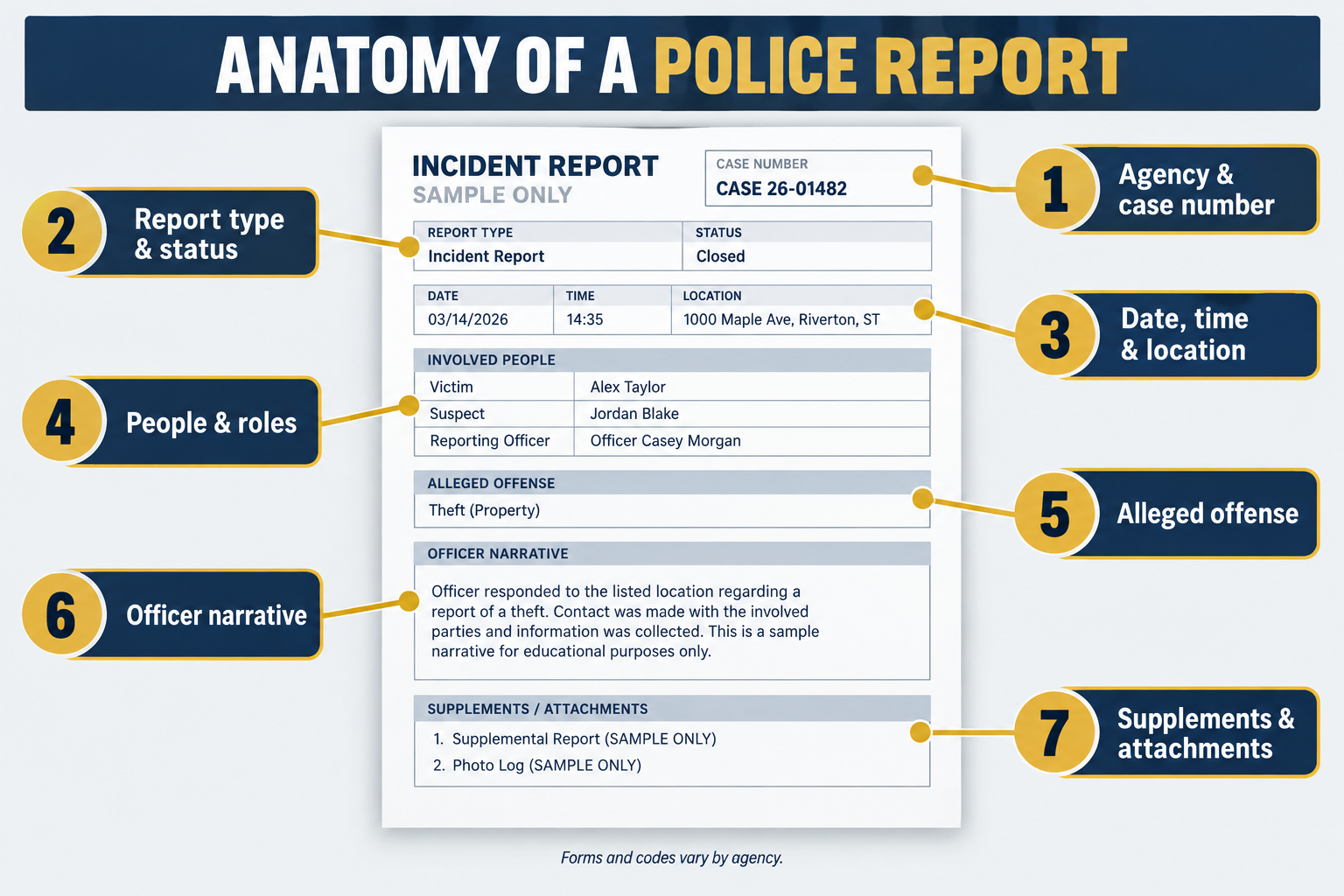
A police report is easiest to read in layers: first identify the report type and case number, then confirm the people, date, time, and location, and only then read the officer’s narrative, codes, diagrams, and supplemental reports. Do not treat a single checkbox, role label, or sentence as the whole conclusion.
The details and terminology vary between agencies. An incident report, arrest report, and traffic crash report may look very different, even when they describe the same event. This guide gives you a practical way to read the most common U.S. police reports without assuming that every department uses the same form.
Look for: Agency, case number and report type.
Why it matters: Confirms you have the right record.
Look for: Date, time, location, people and vehicles.
Why it matters: Sets the event in context.
Look for: Observations, statements and actions.
Why it matters: Explains what the officer documented.
Look for: The form’s official key or manual.
Why it matters: Codes are not universal.
Look for: Supplements, diagrams, photos and citations.
Why it matters: The first page may be incomplete.
| Start here | What to look for | Why it matters |
|---|---|---|
| Report identity | Agency, case number, report type | Confirms you have the right record |
| Basic facts | Date, time, location, people and vehicles | Sets the event in context |
| Narrative | Observations, statements and actions | Explains what the officer documented |
| Codes and boxes | Use the form’s official key or manual | Codes are not universal |
| Attachments | Supplements, diagrams, photos, citations | The first page may be incomplete |
A police report is an agency record documenting an incident, investigation, arrest, crash, or other police activity. It usually combines structured fields—names, dates, checkboxes, codes—with a written narrative. Some reports also include diagrams, property lists, witness statements, photographs, citations, and later supplements.
After writing and reviewing police reports as an officer, my strongest advice is simple: read the report as a record of what was documented at a particular point in time. It is not automatically a complete account, a court judgment, or proof that every statement in it is true.
The FBI’s National Incident-Based Reporting System illustrates how detailed incident data can become: it captures information about offenses, victims, known offenders, arrestees, and property. But the FBI’s national data standards are not a promise that the public-facing report from every local agency will use the same layout or labels.
Before interpreting any field, find the form title or report type. The same case file can contain several documents.
A call log or computer-aided dispatch record is not necessarily the same thing as an officer’s full report. Likewise, a citation may be part of the case but is not the complete investigative file.
The initial and follow-up reports may also be written by different people. Our comparison of a police officer and a detective explains how patrol and investigative roles commonly divide that work.
Look near the top for the agency name and an identifier labeled case number, incident number, report number, event number, or complaint number. Keep that number when contacting the records unit, insurer, investigator, or attorney.
Also look for labels such as initial, supplemental, amended, approved, pending, or closed. A document marked “initial” may have been written before interviews, video review, lab results, or detective follow-up were completed.
Police reports can contain several different times:
These are not interchangeable. If the report lists a date range, the exact time may be unknown. For location, distinguish the incident address from the reporting party’s address, arrest location, evidence location, or place where a vehicle was found.
Common role labels include reporting party, complainant, victim, witness, suspect, subject, arrestee, driver, passenger, and owner. One person may appear in more than one role, and roles may change as the investigation develops.
A label is not a verdict. “Suspect” means the person was identified in that role for the report; it does not establish guilt. “Victim” often reflects how the alleged offense is classified and does not by itself resolve every disputed fact.
Check whether names are repeated on additional pages and whether the form uses person numbers—such as Person 1 or Driver 2—to connect each person to statements, injuries, vehicles, or property.
An offense field may contain a plain-language description, a state statute, a municipal code, or an agency classification. “Reported,” “suspected,” “attempted,” and “completed” can have specific meanings on the form.
Do not confuse these stages:
Those are separate decisions. A report may document allegations without an arrest, and an arrest report does not tell you the final court outcome.
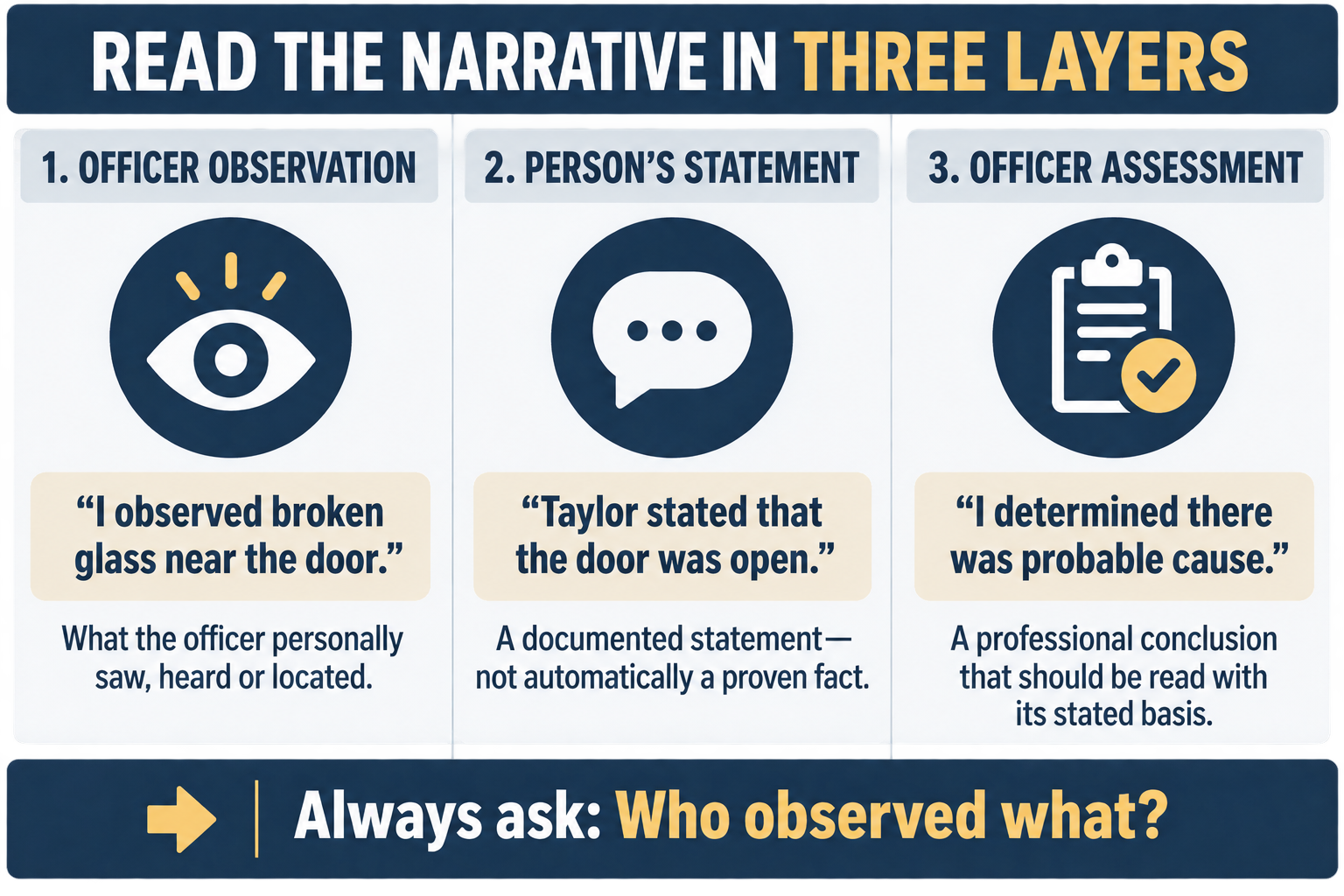
The narrative usually explains why the officer became involved, what the officer observed, what people said, what actions were taken, and what happened next. Read it once for the overall sequence, then a second time while separating three categories:
Typical wording: “I saw,” “I noticed,” “I located.”
How to read it: Something the writer says they personally observed.
Typical wording: “Smith stated,” “the witness reported.”
How to read it: A statement being documented, not automatically adopted as fact.
Typical wording: “I arrested,” “I determined,” “probable cause.”
How to read it: An action or professional conclusion that should be read with its stated basis.
| Category | Typical wording | How to read it |
|---|---|---|
| Officer observation | “I saw,” “I noticed,” “I located” | Something the writer says they personally observed |
| Another person’s statement | “Smith stated,” “the witness reported” | A statement being documented, not automatically adopted as fact |
| Officer action or assessment | “I arrested,” “I determined,” “probable cause” | An action or professional conclusion that should be read with its stated basis |
Pay attention to attribution. “The witness said the car was speeding” is different from “I observed the car speeding.” Also watch for estimated times, paraphrased statements, and references to body-camera footage, photographs, or separate interviews that are not included in your copy.
Do not guess at a code. Abbreviations and number values can mean different things across states and agencies. Radio codes are especially local, and there is no single nationwide list that every department follows.
For a traffic report, search the issuing agency or state transportation department for the exact form name plus “overlay,” “code sheet,” or “instruction manual.” For example, New Jersey publishes an NJTR-1 crash-report form and manual, while California uses its own CHP traffic-collision forms.
Blank, unknown, not applicable, and not reported can be different values. The official instructions should tell you which one a box represents.
A short first page may point to the most important material elsewhere. Look for:
A diagram is usually a simplified illustration, not a scale drawing, unless the report says otherwise. Arrows often show intended travel or movement rather than a precise reconstruction.
Your copy may omit personal identifiers, juvenile information, medical details, witness information, investigative material, or protected evidence. A blacked-out field does not necessarily mean the officer failed to collect it.
If a narrative ends abruptly, page numbering skips, or it references an attachment you did not receive, ask the records unit whether your copy is complete and whether other releasable records exist.
Crash reports deserve extra care because every state designs its own reporting system. The National Highway Traffic Safety Administration publishes the voluntary Model Minimum Uniform Crash Criteria, but NHTSA also notes substantial differences among jurisdictions in definitions, fields, and reporting thresholds.
Use this order:
A state manual can be long because each numbered box has a defined meaning. The New Jersey crash-records page, for example, publishes both the NJTR-1 form and its manual. Use the manual for the version printed on your report.
Imagine this sentence:
“Jones stated that a blue sedan entered the intersection against the red light. I observed damage to the front of Jones’s vehicle and the passenger side of the sedan.”
The first sentence records Jones’s account. The second records the officer’s observation of damage. Neither sentence says the officer personally saw the collision. To understand the report, you would next check the vehicle numbers, traffic-control boxes, other statements, diagram, video references, citations, and any supplemental investigation.
That distinction—who observed what—is one of the most important habits when reading any police narrative.
Start by separating a factual clerical error from a disagreement about an observation or statement. A misspelled name, wrong phone number, transposed license plate, or incorrect insurance detail may be handled differently from a disputed account of how an event happened.
An agency may correct objective data, attach your written statement, or issue a supplement without deleting the original report. Procedures vary, and an officer may not change a professional conclusion merely because a party disagrees with it.
Start with the department that took the report. Its records page may let you request a report online, by mail, or in person. You will usually need the case number or enough identifying details to locate the incident.
Release rules, fees, identification requirements, and waiting periods vary. Active investigations and protected personal information may be withheld or redacted. Federal FOIA rules do not automatically control a city or state police department; state public-records law and local agency policy are usually relevant.
Not by itself. A report can be important evidence, but fault or legal responsibility may be decided later by insurers, prosecutors, judges, or juries using additional evidence and the applicable law.
It describes the status or outcome recorded by the agency, such as an arrest, citation, referral, unfounded classification, suspension, or closure. The available values and their definitions are agency-specific.
The record may be an initial report, a public copy with redactions, or one part of a larger case file. Ask whether supplements or other releasable attachments exist.
Agencies can often correct clerical information or add supplemental material, but processes vary. The original record may remain in the file with a documented amendment rather than being erased.
No. Use the official guide for the exact agency, state, form name, and form version. A number that means one thing on a state crash form may mean something else in another system.
This article provides general educational information about U.S. police reports. It is not legal advice, and local forms, laws, and agency procedures vary.
Police tape—often called crime scene tape—is there for a simple reason: to create a boundary people can see.…
The police are called daily regarding various incidents of public interest. It is our responsibility to provide the…
Many police officers experience terrible, traumatic events in the line of duty, and a significant number turn to…