4 Best Radio Holsters for Duty Belts (Police Picks 2026)
Compare four radio holsters and pouches for police duty belts and outer carriers, including Zero9, Bianchi, 5.11 and…

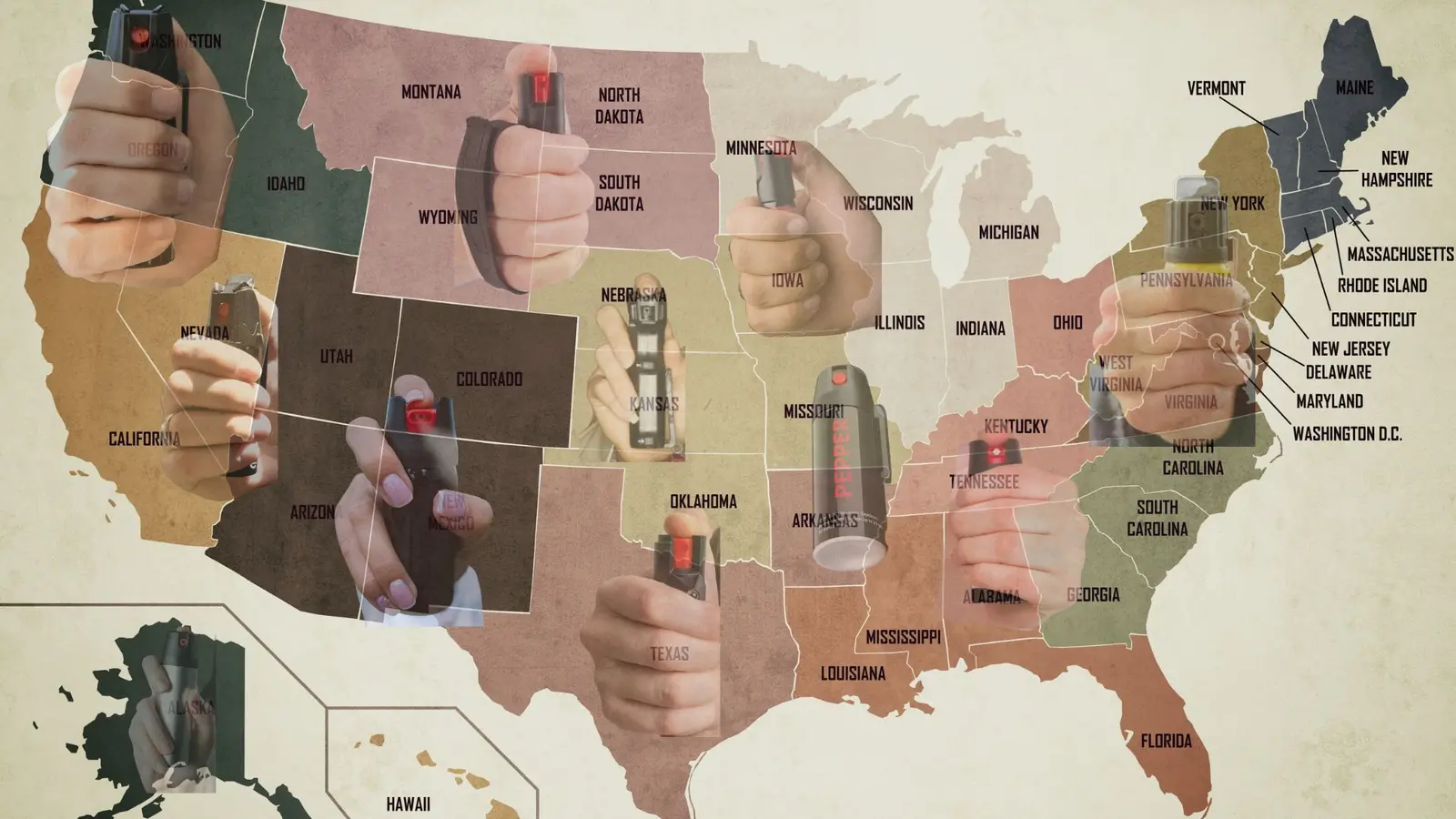
Short answer: ordinary civilian pepper spray is not completely banned statewide in any of the 50 states. That does not make every spray legal everywhere. A number of states restrict the container size, formula, buyer’s age, seller, prohibited persons or the circumstances in which it may be carried and used.
The table below is meant to answer the first question quickly: “Is pepper spray legal in my state?” It also points out the statewide rules most likely to affect an ordinary buyer. It is not a substitute for reading the current law, especially if you are under 18, have a criminal conviction, are buying a large canister or plan to carry it at a school, government building, airport or private venue.
Pepper spray can cause intense pain, temporary vision impairment, breathing difficulty and panic. The fact that you may legally possess it does not mean every use is lawful. Most self-defense laws turn on whether the force was reasonable and immediately necessary under the circumstances.
Last reviewed September 12, 2026. This is general information, not legal advice. Laws change, and local ordinances and location-specific rules can be stricter. Check the linked current law and the relevant local authority before buying, carrying or traveling with a spray.
On a phone, scroll to your state in the table. On a computer, use your browser’s Find command and type the state name. Read the full “key statewide rules” cell rather than relying on the status label alone.
“Generally legal” means we did not identify a special statewide age, size or purchase rule to highlight in this guide. It does not mean unrestricted carry or use. An em dash in the last column is not a promise that no other law applies.
| State | Status | Key statewide rules |
|---|---|---|
| Alabama | Generally legal | — |
| Alaska | Generally legal | — |
| Arizona | Generally legal | — |
| Arkansas | State-specific rules | Self-defense only; maximum 300 mL. The limit was raised from 150 cc in 2021. Act 566. |
| California | State-specific rules | Aerosol container no larger than 2.5 oz; no sales to minors, and possession is restricted for minors and certain prohibited persons. Penal Code §22810. |
| Colorado | Generally legal | — |
| Connecticut | Generally legal | No statewide age, size or purchase rule identified; location and employer rules can still be stricter. |
| Delaware | Generally legal | No state age or size limit identified. Defensive use must satisfy Delaware’s self-defense law. |
| Florida | State-specific rules | A lawful self-defense spray may contain no more than 2 oz of chemical. Fla. Stat. §790.001. |
| Georgia | Generally legal | — |
| Hawaii | Local rules vary | County rules matter. Honolulu requires buyers to be 18+, limits products to qualifying OC spray and regulates sellers; its current code states no numerical ounce cap. Kauaʻi requires 18+ and caps containers at 2 oz. Honolulu code; Kauaʻi code text. |
| Idaho | Generally legal | — |
| Illinois | State-specific rules | The personal-defense spray exemption applies to people age 18 or older; no statewide size limit identified. 720 ILCS 5/24-1. |
| Indiana | Generally legal | — |
| Iowa | Generally legal | — |
| Kansas | Generally legal | — |
| Kentucky | Generally legal | — |
| Louisiana | Generally legal | — |
| Maine | Generally legal | — |
| Maryland | State-specific rules | A seller or other transferor may not provide pepper mace to a minor. No statewide canister-size limit identified. Public Safety §5-134. |
| Massachusetts | State-specific rules | Adults 18+ do not need an FID card. Sales must be through a licensed seller; minors need a self-defense spray permit. No state size cap stated. Mass.gov guidance; M.G.L. c.140 §122C. |
| Michigan | State-specific rules | Qualifying spray is limited to 18% OC, or up to 35 grams of CS/inert ingredients. Sales to minors are prohibited. MCL 750.224d. |
| Minnesota | State-specific rules | Aerosol must have instructions, warnings and a useful-life date. Under 16 requires written parental permission; certain prohibited persons cannot possess it. No state size cap. Minn. Stat. §624.731. |
| Mississippi | Generally legal | — |
| Missouri | Generally legal | — |
| Montana | Generally legal | — |
| Nebraska | Generally legal | — |
| Nevada | Formula matters | Natural-substance OC is excluded from Nevada’s statutory “tear gas” definition. CS devices are governed separately, including a 2 oz limit and seller records. Check the product formula rather than relying on a generic “2 oz pepper spray” claim. NRS 202.370–.440. |
| New Hampshire | Generally legal | — |
| New Jersey | State-specific rules | Age 18+, no criminal conviction; one pocket-sized device containing no more than 0.75 oz for personal self-defense. N.J.S.A. 2C:39-6(i)(1). |
| New Mexico | Generally legal | — |
| New York | State-specific rules | Age 18+; compliant OC-only device no larger than 0.75 oz and no more than 0.7% total capsaicinoids. Sales are limited to licensed or authorized sellers, with proof/certification and no more than two devices per transaction. Felony and assault conviction restrictions apply. Penal Law §265.20; 10 NYCRR §54.3. |
| North Carolina | State-specific rules | Self-defense exemption for people without a felony conviction; maximum 150 cc per container, or 50 cc for a cartridge or shell. G.S. §14-401.6. |
| North Dakota | Generally legal | — |
| Ohio | Generally legal | — |
| Oklahoma | Generally legal | — |
| Oregon | Generally legal | — |
| Pennsylvania | Generally legal | No statewide pepper-spray-specific age, size or purchase rule identified; special place and context rules still apply. |
| Rhode Island | State-specific rules | Carry and defensive use are expressly allowed for people age 18+; no statewide size or formula cap stated. R.I. Gen. Laws §11-47-57. |
| South Carolina | State-specific rules | Self-defense only; container capacity may not exceed 50 cc (about 1.69 fl oz). The statute itself states no minimum age. S.C. Code §16-23-470. |
| South Dakota | Generally legal | — |
| Tennessee | Generally legal | — |
| Texas | Generally legal | — |
| Utah | Generally legal | — |
| Vermont | Generally legal | — |
| Virginia | Generally legal | — |
| Washington | State-specific rules | Age 18+, or ages 14–17 with parent/guardian permission. No state size limit stated. Local governments may not prohibit authorized possession or lawful defensive use. RCW 9.91.160. |
| Washington, D.C. | State-specific product rules | The aerosol must carry instructions and a useful-life date; use is limited to reasonable defense of person or property. Registration has been repealed. D.C. Code §7-2502.13. |
| West Virginia | Generally legal | — |
| Wisconsin | State-specific rules | Qualifying devices contain OC or CS gel with inert ingredients. Under 18 may possess only when supplied by a parent/guardian; felon possession is prohibited. The old size and concentration rules were repealed. Wis. Stat. §941.26(4). |
| Wyoming | Generally legal | — |
The restriction is not always where you expect it. California, Florida, New Jersey, New York, North Carolina, Arkansas and South Carolina regulate container size. New York also regulates the active ingredient and strength. Other states focus more on age, the seller, prior convictions or the label and safety mechanism.
Also watch the difference between pepper spray (OC) and tear gas such as CS or CN. Nevada is a good example: natural-substance OC is excluded from the statutory tear-gas definition, while CS devices fall under a different set of rules. A table that simply says “Nevada: 2 oz maximum” misses that distinction.
Places can have their own rules even when possession is generally lawful. Schools and campuses, courthouses, secured government buildings, public transit systems, workplaces and private venues may prohibit sprays. Hawaii deserves extra care because county rules differ.
Not in carry-on baggage. For a U.S. domestic flight, federal rules allow one self-defense spray of 4 fl oz (118 mL) or less in checked baggage if it has a positive safety mechanism against accidental discharge. A recessed button by itself is not enough. Sprays containing more than 2% by mass of CS or CN tear gas are prohibited, and some airlines do not accept pepper spray at all. International aviation rules prohibit self-defense sprays in both carry-on and checked baggage. See the current TSA guidance and FAA PackSafe guidance.
No state has a blanket statewide ban on ordinary civilian pepper spray for lawful self-defense. Several states only protect possession of a device that meets their size, formula, age or purchaser rules, so the practical answer still depends on the state and the exact product.
“Mace” is often used as a generic word, but a product may contain OC pepper spray, CS/CN tear gas or a blend. Those formulas are not treated the same in every state. Check the active ingredient on the label rather than relying on the brand name.
Not necessarily. Bear spray is an EPA-regulated pesticide made and labeled for use against bears, and the canisters are usually much larger. See our separate explanation of bear spray vs. pepper spray.
Check the canister’s net contents, active ingredients, concentration, safety mechanism and expiration date against your state and local rules. Then make sure you understand how the spray operates. Our guides cover pepper sprays for self-defense, how to use pepper spray and what pepper spray does to the body.
Compare four radio holsters and pouches for police duty belts and outer carriers, including Zero9, Bianchi, 5.11 and…
Compare four of the best law enforcement duty belts for police officers, including Bianchi, 5.11 and Condor options.…
The best police scanners depend on your local radio system. Compare six current digital and P25 scanners, including…