4 Best Radio Holsters for Duty Belts (Police Picks 2026)
Compare four radio holsters and pouches for police duty belts and outer carriers, including Zero9, Bianchi, 5.11 and…

Every uniformed cop with a shred of professional pride carries a knife. All right, not literally every cop—but a knife is common police equipment for a reason.
For most officers it is a tool first: cutting a seat belt, opening packaging, trimming cord or dealing with one of the hundred small problems that appear during a shift. The job should decide the knife. Patrol, traffic, plainclothes work and specialist assignments do not create the same needs.
My practical picks are the KA-BAR TDI for a compact duty-belt fixed blade, the Smith & Wesson SWHRT3BF for a simple fixed blade, and the Gerber Hinderer CLS for rescue work. The other five cover folding, assisted-opening and discreet backup options.
Before carrying any of them on duty, check agency policy and state and local law. Blade length, opening mechanism, placement and whether a knife may be carried as a weapon can all be regulated separately.





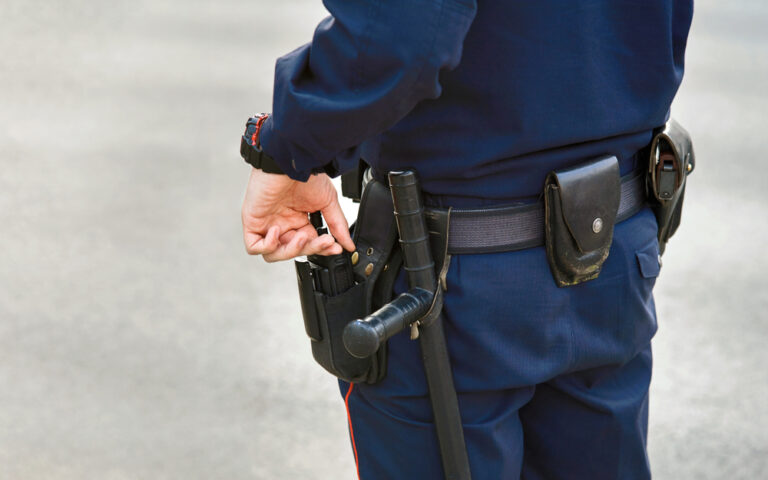
A duty-belt knife is simply a knife mounted on the belt rather than clipped inside a pocket or stored in a patrol bag. Officers carry them for different reasons: utility, rescue work and, in some agencies, as a last-resort defensive tool.
The useful ones are compact enough not to crowd the belt, but still secure and reachable. Placement and sheath retention matter just as much as blade steel.
As an experienced police officer, there is one duty-belt knife that stands out to me: the KA-BAR TDI. Most officers will recognize the curved handle and compact fixed-blade design, although that does not mean every officer needs one.
The TDI was designed as a weapon-retention tool, but buying the knife is not the same as knowing how to use it. Anyone considering it for that role needs agency approval and proper hands-on training. The curved handle does make it easier to reach while seated, and the compact sheath takes up little room.
There are several sizes. I personally recommend the 5 5/8-inch version because it leaves valuable room for the other equipment already competing for space on a duty belt.
This knife can be purchased on Amazon. Or you can click here to make sure you get the correct one with a hard sheath and clip.
“Tactical knife” is a loose marketing term rather than one precise knife category. In practice, it usually means a durable knife designed for hard use, reliable grip and quick access.
A tactical knife can be fixed or folding. For police work, the more useful distinction is what the officer actually needs it to do: routine cutting, rescue work or a specialist task.
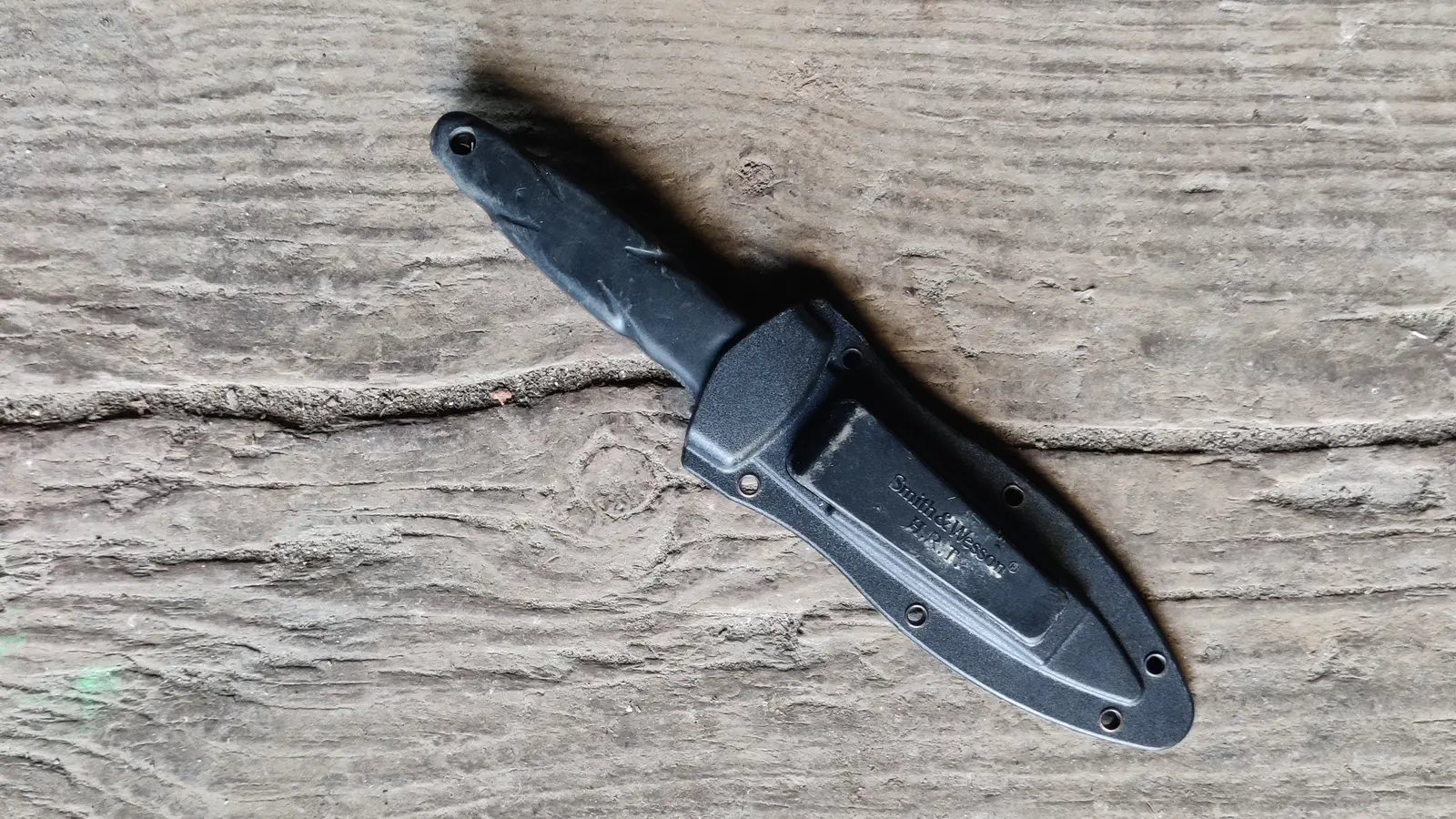
My top fixed-blade choice is the Smith & Wesson SWHRT3BF. It has a simple double-edged design without a lot of additions, and there is no need to carry a large Rambo knife. I have personally used this model for off-duty EDC for the last ten years.
A fixed blade needs a sheath, so carry options are more limited than with a folding knife and pocket clip. The advantage is consistency: the knife stays in one known location. The tradeoff is that the sheath and exposed handle need secure retention.
In my opinion, every cop should have a rescue knife. You don’t have to carry it at all times, but you should have it in your patrol bag or your car so that it’s easily accessible. Rescue knives can be utilized when an accident has occurred. They are not intended for self-defense or any other purposes. There are two primary features every rescue knife should have: a strap cutter and a glass breaker.
The strap cutter is primarily used to cut unconscious people’s seat belts off when you’re rescuing them from an unfortunate event, such as a car accident. Believe it or not, I have also used my rescue knife to cut the rope down on people who have tried to kill themselves by hanging.
A protected strap cutter keeps most of the cutting edge away from the person, reducing the risk compared with working a pointed blade close to the body.
The glass breaker is the sharp, pointy metal at the butt of the knife. Imagine a police officer trying to break a car window? We are often surprised at how hard it is, even with a baton.
A proper glass breaker concentrates force into a small point and can break tempered side glass with less effort than a baton. Laminated glass may crack without opening, however, so the tool is not a guarantee of entry into every modern vehicle.
I would not choose a rescue knife because a manufacturer markets the glass breaker as an impact weapon. Its job here is breaking suitable vehicle glass; defensive use is a separate legal, policy and training question.
In my opinion, the best rescue design in this group is the Gerber Hinderer CLS. There is one catch: the model is no longer easy to find new, so it may appear only as old stock or used.
It has the two features I want—a glass breaker and protected strap cutter—plus an oversized thumb stud that is easier to use with safety gloves. If you find one, check the condition and price rather than assuming old stock is still the best value.
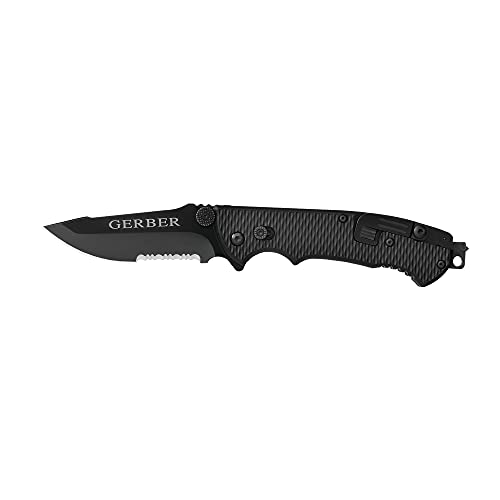
A folding knife trades some of a fixed blade’s simplicity for easier carry. Most have a pocket clip, which is where I would rather carry one than add another pouch to an already crowded duty belt. Folding rescue knives may also include a strap cutter and glass breaker.
Why should a cop have a folding knife? For starters, they are just nice to have. There will eventually be a box, strap or stubborn bit of packaging that needs cutting. A second knife only makes sense if it serves a different purpose or stays in a patrol bag as a backup.
I have asked many colleagues which folding knife they prefer to carry and most of them replied with one of the following:
This is the cheap, replaceable option. It suits someone who tends to misplace equipment or simply does not want to spend heavily on a utility knife. Prices change, so judge it as the budget pick rather than by an exact dollar figure.
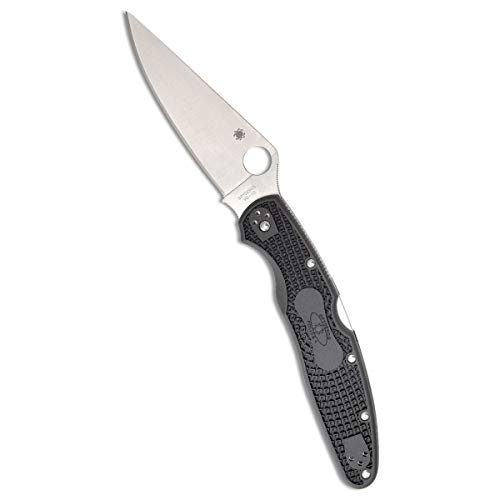
This knife has been very popular with law enforcement since the 80s. They were specifically made to be the best folding knives for police officers, so it’s no wonder. The Spyderco Police knife has now reached its fourth model and is as popular as ever.
Don’t be fooled by the photos; it is much bigger than it looks and measures nearly ten inches open. The Lightweight model is the more practical version for pocket carry.
An automatic knife opens when a button or similar control releases the blade. With an assisted-opening knife, the user must first apply pressure directly to the blade or flipper; the spring assists only after that movement begins.
Buyer beware: rules for automatic and assisted-opening knives vary by state, locality and agency. Law-enforcement status does not automatically settle every ownership or carry question, so check the rules that apply where you work.
With that warning made, the Smith & Wesson Velocite is my assisted-opening pick in this group.
The matte blade is discreet, the assisted-opening mechanism feels smooth, and the textured polymer handle provides a useful grip. None of those features makes a knife inherently safe; the lock, handling and training still matter.
There are several types of knives that law enforcement agencies use. It depends on the unit they belong to and their primary tasks. We’ll take a quick look at two of the most relevant knives and one that is a no-go.
Boot knives come from military and defensive use, where a small fixed blade can be carried away from the main equipment.
There are no realistic scenarios that come to mind where law enforcement may need a boot knife. However, cops are often interested in having as much gear as possible, and I personally know many who carry one on their person. The most popular boot knife to date is the Ka-Bar TDI Last Ditch.
Some plainclothes officers carry small knives on the ankle to keep pockets and the belt clear. The Gerber Ghoststrike is one option, but concealed carry and placement must comply with law and agency policy.
Personally, I would choose an ankle knife only when the assignment and clothing make it more practical than a pocket clip. Discreet carry is not a substitute for lawful carry, secure retention or training.
A ballistic knife launches a detachable blade instead of merely opening it. It is not a police utility tool and is prohibited or tightly restricted in many places. I cannot imagine a legitimate duty reason for an officer to carry one.
Many do, but usually as a personally purchased utility or rescue tool rather than issued equipment. Some carry no knife at all. Agency policy and the officer’s assignment should decide whether it belongs on the belt, in a pocket or in the patrol bag.
A folding knife is easier to carry and is usually the practical choice for routine cutting. A fixed blade is simpler and quicker to access but needs a secure sheath, occupies more space and may face tighter policy or legal restrictions.
Look for a protected seat-belt cutter, a glass breaker intended for tempered side glass, a reliable lock and controls large enough to use with gloves. It should complement—not replace—the dedicated rescue tools and training available through the department.
Start with the assignment, not the most aggressive-looking knife. A patrol officer who mainly needs a cutting tool has different requirements from a traffic officer choosing a rescue knife or a specialist considering a fixed blade.
The useful questions are ordinary ones: Can it be opened with one hand? Does the lock feel dependable? Can you grip it with wet or gloved hands? Is the carry position secure and consistent?
Handle the knife before buying if possible. A local outdoor or duty-gear store will tell you more about grip, size and pocket placement than another hour of reading specifications.
Whatever you choose, keep it sharp, clean and familiar. A dull rescue blade or a folding knife you cannot open under stress is just extra weight.
For more information about police gear, see our articles about important items you need as a police officer, patrol bag contents and multi-tools for police.
Compare four radio holsters and pouches for police duty belts and outer carriers, including Zero9, Bianchi, 5.11 and…
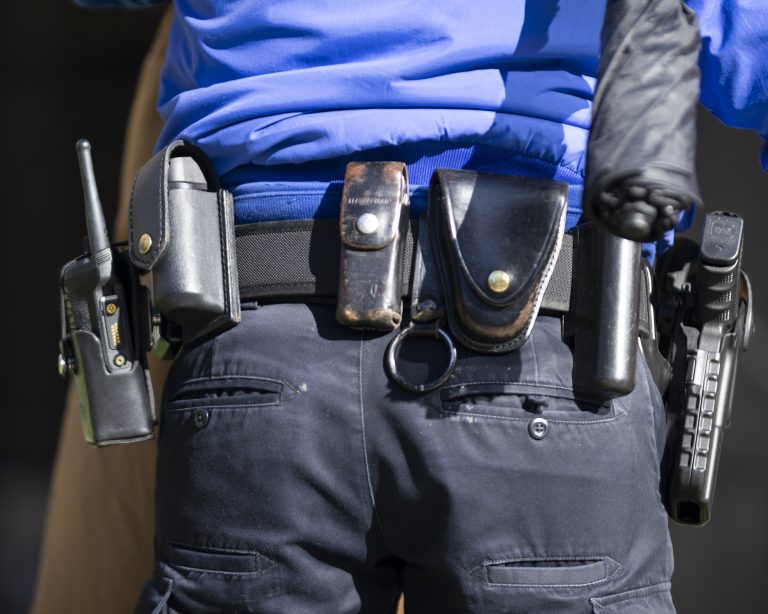
Compare four of the best law enforcement duty belts for police officers, including Bianchi, 5.11 and Condor options.…
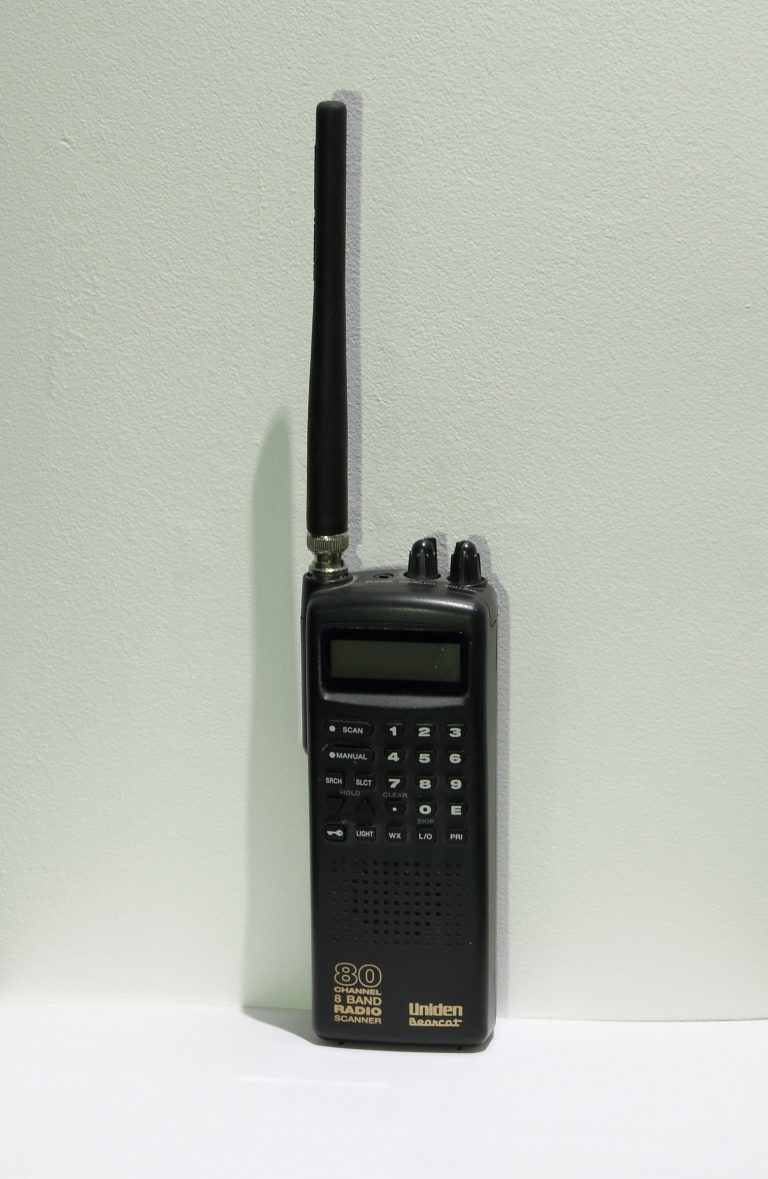
The best police scanners depend on your local radio system. Compare six current digital and P25 scanners, including…