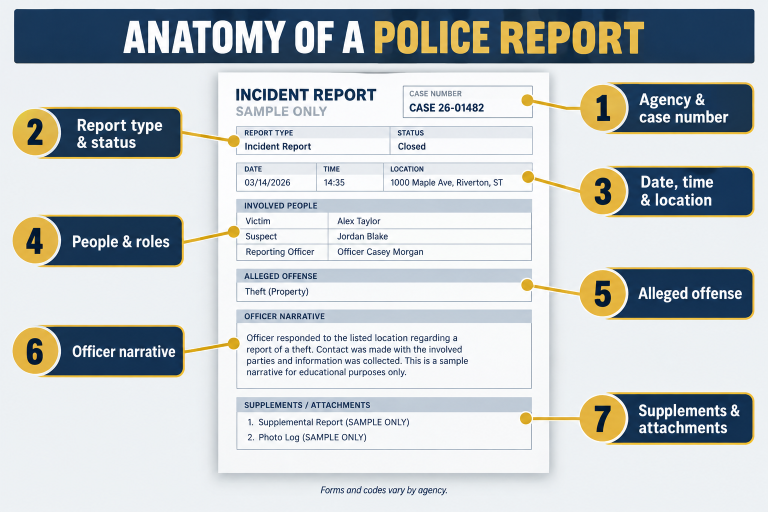
How to Read a Police Report: A Step-by-Step Guide
Learn how to read a police report, from case numbers and codes to officer narratives, crash diagrams, supplements,…

When I first prepared this article, I read 120 police officer job descriptions on Indeed, Police1 and other recruitment sites. I wanted to see which police officer skills employers actually asked for, rather than simply making another list of admirable words.
The five themes that appeared most often were knowledge, practical ability, teamwork, interpersonal skills and communication. The job descriptions naturally emphasized trainable “hard” skills: driving, equipment, defensive tactics and knowledge of the law. My experience is that the softer skills carry more of the ordinary working day. Most police work is done by talking, listening, judging and writing—not by using force.
You do not need a perfect score on all 23 qualities below. Some can be trained quickly; others take experience and honest self-examination. A quiet person can become an excellent officer, and an outgoing person can be a poor one. Personality is not a shortcut around professionalism.
If you are considering the career, a police ride-along is one of the best ways to watch these skills being used outside a classroom.
Communication is at the center of police work. Officers use it to gather information, calm conflict, give clear instructions and explain decisions to people who may be frightened, angry or confused.
“Verbal agility” helps, but communication is more than finding impressive words. Your voice, facial expression, distance, timing and body language all affect the message. If the words are calm but the rest of you looks hostile, people usually notice the contradiction.
During a police career, you will write countless reports. Some will be read months later by investigators, prosecutors, defense attorneys or a court. The reader was not standing beside you, so the report has to make the event understandable without exaggeration or guesswork.
Spell-checking is the bare minimum. A useful report is accurate, chronological where appropriate and direct. Separate what you saw and heard from what somebody else told you. Fancy language does not rescue missing facts.
Hearing and listening are different. Hearing is passive. Active listening means following what the person is saying, noticing what has not been answered and checking that you understood correctly.
Eye contact, nodding and repeating an important point can help, but they are not a performance. The goal is to understand the account and make the person feel heard without promising that you agree with every conclusion.
An officer needs knowledge of the law, local procedures, the community and recurring problems. Nobody knows everything between heaven and earth, although people often ask the police as if we do.
The useful skill is knowing what you know, recognizing what you do not know and finding the right person or source. Laws, policies and communities change. An officer who stopped learning at the academy soon becomes confidently outdated.
A dispatch message is only the information available before you arrive. A routine traffic stop can change quickly. A call reported as a traffic accident may turn out to involve several stabbing victims and a suspect still nearby.
You will often arrive at a different scenario than the one you pictured. On the way to a call, I find it useful to think through several possibilities—not to decide what happened in advance, but to avoid being mentally locked into one version.
Attention to detail does not mean counting the buttons on everybody’s shirt or knowing how your doctor ties his shoes. It means noticing details that may affect safety, evidence or the reliability of an account.
It also applies to ordinary tasks: reading the full dispatch, following a supervisor’s instruction, checking names and numbers, and noticing what has changed since the last patrol through an area.
Not everything is how it first appears. People may lie, remember incorrectly or describe the same event from genuinely different perspectives. An officer has to test information instead of selecting the first story that feels right.
Critical thinking also applies to your own work. You are not always right. Ask what evidence would change your mind, and seek another officer’s perspective when time permits.
“Friendly” appeared in my original list, but approachable is the better word. An officer does not have to smile through every situation. People do need to feel that they can give you information, ask a question or admit that they do not understand.
A small effort here can produce better cooperation. It also affects public trust in the police long after the specific call is over.
Empathy helps an officer understand how a situation may look and feel to another person. Compassion influences how we treat people once we understand it. Neither requires abandoning the law or accepting every explanation as true.
There is a practical balance. If you absorb every person’s pain as your own, the job can become unbearable. If you shut it out completely, you stop seeing the people behind the incidents. Being decent and showing appropriate empathy builds rapport and trust—two things police officers cannot afford to mess up.
Police work can require running, lifting, controlling a dangerous person or continuing to function after hours of fatigue. Physical readiness protects the officer, colleagues and the public.
This is not about looking like a fitness model. It is about maintaining enough strength, endurance and mobility for the tasks your role may demand. Many recruits arrive in good shape and then let shift work slowly undo it. Continuing to train makes the job and later life easier.
Open-mindedness means being willing to consider new information and a better argument. It does not mean having no convictions. It means your conclusion is allowed to change when the facts change.
The old version of this article joked that the least you could do was pretend to be open-minded. Pretending may protect appearances for a moment, but it does not improve decisions. Genuine curiosity is more useful.
An officer must treat people fairly regardless of race, religion, sex, sexual orientation, social position or personal sympathy. That requires more than saying “I treat everyone the same.” Different communities may communicate, respond to authority and interpret behavior differently.
Cultural awareness helps you avoid mistaking unfamiliar behavior for suspicious behavior. Impartiality keeps the decision tied to conduct, evidence and law.
Assertiveness is the ability to be clear, firm and in control without becoming needlessly aggressive. People and situations will test you. Hesitation can create confusion, but shouting does not automatically create authority.
Members of the public generally appreciate an officer who explains what must happen and then follows through. Confidence works best when it is paired with respect and the willingness to correct yourself.
Police officers solve problems every day, so being proactive matters. That does not mean doing everything yourself or inventing work to look busy. It means recognizing what needs to happen and taking a lawful, sensible next step.
Sometimes the solution is action. Sometimes it is knowing who to call, which service can help or when to slow the situation down.
The public gives police significant authority and expects it to be used responsibly. You are trusted to show up, care for equipment, complete reports, follow through on tasks and own your decisions.
Responsibility also means admitting an error early enough for it to be corrected. Hiding a small mistake can turn it into a much larger one.
Courage is the ability to act despite fear. It does not mean being stupid. Running into a gunfight without a plan or a reasonable chance of stopping the threat may simply add another casualty.
Physical courage is only one form. It also takes courage to sit with a victim of a serious crime, challenge misconduct by a colleague or admit that your first assessment was wrong.
Integrity is the steady moral compass behind the public role. It matters when no supervisor is present and when the easier choice would be to ignore a problem.
The FBI Law Enforcement Bulletin’s discussion of an ideal police officer likewise emphasizes qualities including integrity, ethics, empathy, communication and sound judgment. Technical competence without character is not enough.
Policing is not a one-person job. On calls, your safety may depend on colleagues reading the situation, communicating and doing their part. In investigations, several people bring knowledge and perspectives that one investigator cannot possess alone.
Being a team player does not mean agreeing with everything. A good colleague shares information, gives useful feedback and speaks up before a bad decision becomes a group decision.
Every day brings somebody else’s problem. Many are simple; some demand a quick decision with incomplete information. The basic process is to define the actual problem, identify realistic options, choose one, act and then check whether it worked.
Experience makes this faster, but it should not make it automatic. Familiar situations can still contain one unfamiliar detail. And remember: you are not alone. Calling somebody with the right expertise is often good problem-solving.
First aid is unquestionably a police skill, particularly on patrol. Officers encounter traffic collisions, assaults, gunshot and knife wounds, overdoses and cardiac emergencies. Sometimes police arrive before medical personnel.
Training has to be current. Carrying a police first aid kit or a tourniquet is useful only when you understand your equipment and follow the applicable protocol.
You will meet genuinely funny situations. You will also encounter difficult situations where appropriate humor helps colleagues release tension afterward. Used badly, it can humiliate somebody or make the public think an officer does not care.
This clip of two Norwegian police officers still makes the point better than another definition:
Humor can be a strength when it connects people and helps an officer cope. It becomes a weakness when the joke is at the expense of a vulnerable person.
Honesty and integrity overlap, but they are not identical. Integrity is the wider standard; honesty is telling the truth in reports, testimony, conversations and explanations of your own conduct.
Being a police officer but not being honest simply does not rhyme. Credibility can take years to build and one dishonest report to destroy.
Police officers cannot go over the line. Force must be lawful, necessary and proportionate under the rules that apply. Once the need for force ends, continuing changes the nature of the act.
Self-control also matters before force is considered. People may insult, provoke or challenge an officer. The authority of the position is not permission to win a personal argument.
If I had to reduce the list, I would start with integrity, communication, judgment, adaptability and self-control. Those qualities support almost everything else. Practical skills can be trained, but they have to be guided by character.
You will grow into many parts of the job. The useful question is not whether you already look like the perfect officer. It is whether you can take feedback, keep learning and carry authority without letting it become your personality. If you are still deciding, my longer guide asks the harder question: Should I become a cop?
Learn how to read a police report, from case numbers and codes to officer narratives, crash diagrams, supplements,…
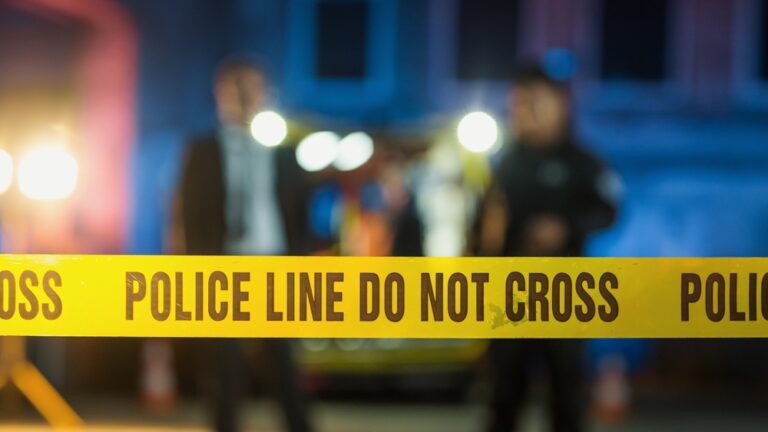
Police tape—often called crime scene tape—is there for a simple reason: to create a boundary people can see.…
The police are called daily regarding various incidents of public interest. It is our responsibility to provide the…